Github Copilot CLI Notification Settings in WSL
Table of Contents
Overview
In this article, I’ll show you how to set up Windows Toast notifications for Github Copilot CLI running in WSL using a custom notification script and the BurntToast PowerShell module.
- Install BurntToast in Windows Powershell
- Create a notification script in WSL that sends notifications via PowerShell
- Configure Github Copilot CLI hooks to trigger the notification script on specific events (e.g., when a session ends or when a prompt is submitted)
- Test the setup by running a Github Copilot CLI command and confirming you receive a Windows Toast notification
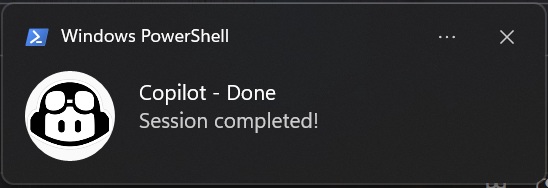
Install BurntToast in Powershell
Install the BurntToast module in Powershell to send Windows Toast notifications from WSL.
Install-Module -Name BurntToast -Force -Scope CurrentUser
Confirm your execution policy allows running scripts:
Get-ExecutionPolicy -Scope CurrentUser
If the execution policy is too restrictive (e.g., Restricted), set it to RemoteSigned:
Set-ExecutionPolicy -ExecutionPolicy RemoteSigned -Scope CurrentUser
You can now send test notifications from Powershell to confirm BurntToast is working:
Import-Module BurntToast
New-BurntToastNotification -Text "Test Notification", "BurntToast is working!"
(Optional) Put Custom Logo for Notifications
You can use a custom logo for the notifications by placing an image file (e.g., logo.png) in a Windows directory. In this article, we put the logo in D:\your\logo\path\logo.png. Update the ICON variable in the script below with the path to your logo.
You can test the notification with the custom logo:
Import-Module BurntToast
New-BurntToastNotification -Text "Test Notification", "BurntToast is working!" -AppLogo "D:\your\logo\path\logo.png"
Create Notification Script in WSL
Create a script file for example vim ~/.bin/copilot-notify.sh and add the following content:
#!/bin/bash
# copilot-notify.sh
# Sends a Windows Toast notification when Copilot CLI hooks are triggered.
# Copilot CLI passes hook data as JSON via stdin.
# The hook event name is passed via COPILOT_HOOK_EVENT env var.

# Ensure common binaries are available
export PATH="/usr/local/sbin:/usr/local/bin:/usr/sbin:/usr/bin:/sbin:/bin:$PATH"

# Read JSON payload from stdin
STDIN=$(cat)

# Debug log — uncomment to troubleshoot
#{
#  echo "=== $(date) ==="
#  echo "COPILOT_HOOK_EVENT: $COPILOT_HOOK_EVENT"
#  echo "STDIN: $STDIN"
#} >> /tmp/copilot-hook-debug.log 2>&1

# Set notification title and message based on hook event
case "$COPILOT_HOOK_EVENT" in
  "sessionEnd")
    TITLE="Copilot - Done"
    MESSAGE="Session completed!"
    ;;
  "preToolUse")
    TITLE="Copilot - Action Needed"
    MESSAGE="Waiting for your input!"
    ;;
  "errorOccurred")
    TITLE="Copilot - Error"
    MESSAGE="An error occurred!"
    ;;
  *)
    TITLE="Copilot"
    MESSAGE="Notification"
    ;;
esac

# Convert WSL icon path to Windows path for PowerShell
ICON="/mnt/d/your/logo/path/logo.png"
WIN_ICON=$(wslpath -w "$ICON" 2>/dev/null)

# Send Windows Toast notification via BurntToast PowerShell module
/mnt/c/Windows/System32/WindowsPowerShell/v1.0/powershell.exe -Command "
Import-Module BurntToast
New-BurntToastNotification -Text '$TITLE', '$MESSAGE' -AppLogo '$WIN_ICON'
" 2>/dev/null

# Fallback: terminal bell in case PowerShell notification fails
echo -e "\a"
Make the script executable:
chmod +x ~/.bin/copilot-notify.sh
Configure Copilot CLI Hooks
Create hooks.json
Create a hooks configuration file. We’ll store it centrally at ~/.copilot/hooks.json and symlink it into each project:
{
  "version": 1,
  "hooks": {
    "sessionEnd": [
      {
        "type": "command",
        "bash": "/home/your-username/.bin/copilot-notify.sh",
        "timeoutSec": 10,
        "env": { "COPILOT_HOOK_EVENT": "sessionEnd" }
      }
    ],
    "preToolUse": [
      {
        "type": "command",
        "bash": "/home/kktsuji/.bin/copilot-notify.sh",
        "timeoutSec": 10,
        "env": { "COPILOT_HOOK_EVENT": "preToolUse" }
      }
    ],
    "errorOccurred": [
      {
        "type": "command",
        "bash": "/home/your-username/.bin/copilot-notify.sh",
        "timeoutSec": 10,
        "env": { "COPILOT_HOOK_EVENT": "errorOccurred" }
      }
    ]
  }
}
Replace /home/your-username/.bin/copilot-notify.sh with the actual path to your notification script.
The available hook events are:
| Event | Description |
|---|---|
sessionStart |
Session started |
sessionEnd |
Session completed |
userPromptSubmitted |
User submitted a prompt |
preToolUse |
Before a tool is used |
postToolUse |
After a tool is used |
errorOccurred |
An error occurred |
For more details on hooks, see the Using hooks with GitHub Copilot CLI documentation.
Symlink hooks.json into Your Project
Copilot CLI loads hooks from .github/hooks/hooks.json in the current working directory. Create a symlink in each project where you want notifications:
mkdir -p your-project/.github/hooks
ln -s ~/.copilot/hooks.json your-project/.github/hooks/hooks.json
This way, you maintain a single hooks.json and share it across multiple projects.
Test with Copilot CLI
Go to your project directory and run the Copilot CLI:
cd your-project
copilot
Then send a small request to trigger the hooks, for example:
> hi
If everything is set up correctly, you should see Windows Toast notifications when:
- The session ends (
sessionEnd) - An error occurs (
errorOccurred)
Debugging
If you don’t see notifications, enable the debug logging in ~/.bin/copilot-notify.sh by uncommenting the debug block:
# Debug log — uncomment to troubleshoot
{
  echo "=== $(date) ==="
  echo "COPILOT_HOOK_EVENT: $COPILOT_HOOK_EVENT"
  echo "STDIN: $STDIN"
} >> /tmp/copilot-hook-debug.log 2>&1
Then check the log at /tmp/copilot-hook-debug.log:
cat /tmp/copilot-hook-debug.log
If the log file doesn’t exist after running Copilot CLI, the hooks aren’t being loaded. Verify that:
- The symlink is valid:
ls -la your-project/.github/hooks/hooks.json - The hooks.json path is
.github/hooks/hooks.json(not the project root) - The notification script is executable:
ls -la ~/.bin/copilot-notify.sh
You can also test the script directly:
echo '{"timestamp":1704614400000}' | COPILOT_HOOK_EVENT=sessionEnd ~/.bin/copilot-notify.sh
After confirming the setup works, comment out the debug logging lines to avoid unnecessary logging.